
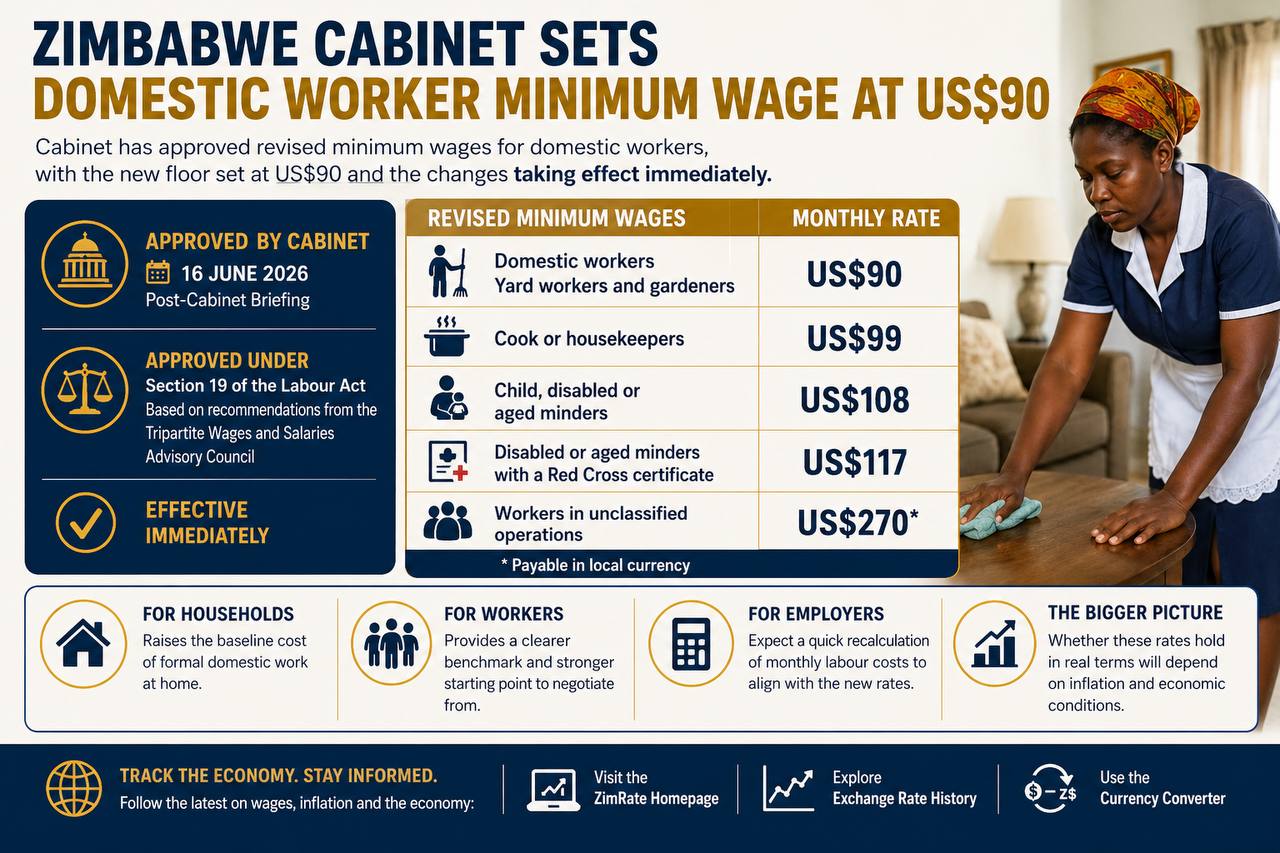
Zimbabwe Cabinet has approved revised minimum wages for domestic workers, with the new floor set at US$90 a month and the changes taking effect immediately (The Herald, PositiveEye News).
That is the headline. The details matter too. According to The Herald's report, yard workers and gardeners are also set at US$90, cook or housekeepers at US$99, child, disabled or aged minders at US$108, and disabled or aged minders with a Red Cross certificate at US$117. Workers in unclassified operations are pegged at US$270, payable in local currency.
The revision came out of Cabinet's 16 June 2026 post-Cabinet briefing. PositiveEye News said the changes were approved under Section 19 of the Labour Act, after recommendations from the Tripartite Wages and Salaries Advisory Council. That gives the move a formal policy footing rather than the feel of a one-off announcement.
For households, the immediate question is simple: what does this mean in practice? For families employing domestic staff, the new floor raises the baseline cost of formal work at home. For workers, it gives a clearer benchmark in a market where wages often move unevenly and the line between informal and formal pay can get blurred fast.
The unclassified-operations rate stands out for a different reason. At US$270, it is much higher than the domestic-worker floor, which suggests Cabinet is trying to separate broad occupational categories rather than apply one flat rate across the board. In a country where many workers move between casual, semi-formal and informal arrangements, that distinction matters.
There is also the issue of timing. Some social posts and reposts framed the change as taking effect from 1 June 2026, but the safest wording from the accessible briefing material is that Cabinet said the revised minimum wages are with immediate effect. That is the version worth sticking with unless the official notice says otherwise.
For employers, the practical response is likely to be a quick recalculation of monthly labour costs. For workers, especially in domestic roles, the shift gives a clearer floor to negotiate from. It will not solve affordability pressures on either side, but it does reset the starting point.
The bigger economic question is whether the new rates will hold in real terms if prices keep moving. Zimbabwe's wage decisions rarely stay isolated for long. They feed into household budgets, service costs, and expectations around what a fair monthly rate should look like.
Readers who want to track how wage changes and inflation pressure feed into the wider economy can follow the ZimRate homepage, compare longer movements on the exchange rate history page, and use the currency converter.
For now, the clean read is this: Cabinet has lifted the wage floor for domestic work, and it has also laid out a more detailed pay scale for related categories. The numbers are out. The market will decide how long they feel adequate.
This article is for informational purposes only and does not constitute financial advice.