
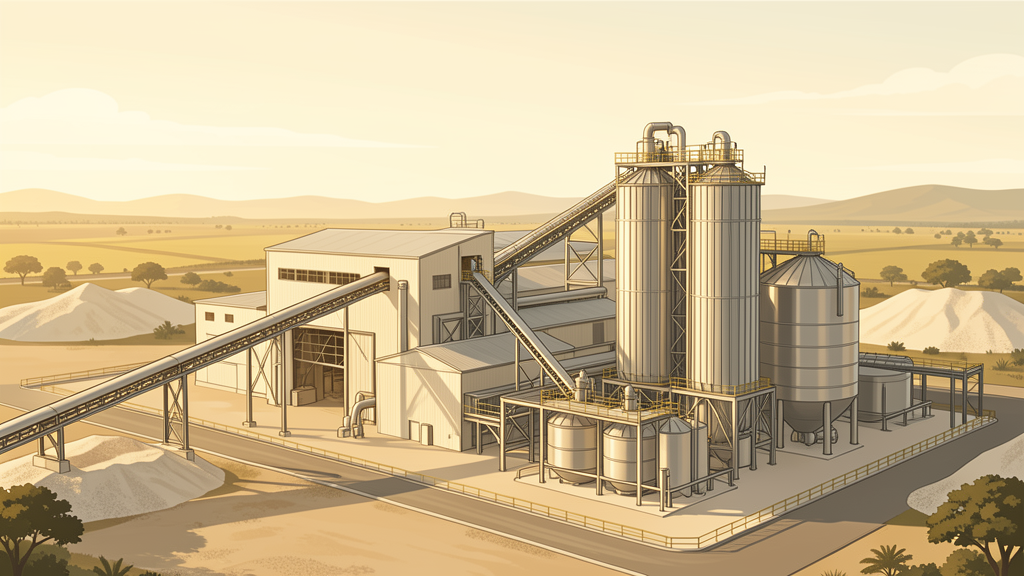
Zimbabwe's lithium story may be moving into a new phase. After spending the past few years exporting concentrate and only recently shipping its first lithium sulphate, the country is now talking about lithium carbonate, a higher-value product used in battery supply chains.
The trigger for that shift was a statement from Mines Minister Polite Kambamura, who said China's Zhejiang Huayou Cobalt plans to produce lithium carbonate in Zimbabwe. The remark matters because Huayou already controls one of the country's most important lithium assets at Arcadia, and because Harare has spent months tightening the screws on raw mineral exports as it pushes miners toward local processing (MINING.com).
For Zimbabwe, this is the real economic question: can the country keep moving up the value chain instead of staying stuck as a shipper of lower-value feedstock? That is what investors, policymakers, and anyone watching export earnings should be asking now.
Why lithium carbonate changes the conversation
Lithium concentrate is useful, but it is still an early-stage product. Lithium sulphate goes a step further. Lithium carbonate sits higher up the ladder again and is more closely tied to battery manufacturing. In simple terms, each step gives Zimbabwe a chance to capture more value from the same mineral base.
That is why Kambamura's comments landed with weight. Zimbabwe is not just chasing volume anymore. It wants higher-value exports, stronger beneficiation, and better retention of mining earnings inside the country. If Huayou does add lithium carbonate production, it would fit neatly into that policy direction.
It would also build on a milestone that already happened this year. In April, Huayou reported the first exports of lithium sulphate from Zimbabwe through Prospect Lithium Zimbabwe at Arcadia in Goromonzi. Reuters described that shipment as the first lithium salt export from Zimbabwe, a symbolic but important step in showing that processing is beginning to happen locally rather than entirely offshore (Reuters).
Harare has been forcing the issue
This story is not happening in a vacuum. The government has been steadily hardening its position on lithium exports. In February, Zimbabwe suspended exports of raw minerals and lithium concentrates, citing malpractice and leakages. It later moved to a quota-based transition while keeping its broader beneficiation policy intact. The direction of travel is clear: ship less raw material, process more at home, and leave miners with fewer excuses.
That matters because industrial policy has often been the weak point in Zimbabwe's mining story. The country has long had the resources, but too often the larger value pools have been captured elsewhere. Lithium is now being treated as a test case. Can Zimbabwe extract the ore, process a bigger share of it domestically, and use that shift to raise export receipts and industrial capability? That is the bet.
Huayou is central to that bet because it already has operating infrastructure on the ground. Its Arcadia asset is not a theoretical project. The company bought the mine, built out processing capacity, and has already moved into lithium sulphate. A push into lithium carbonate would not start from zero. It would be an extension of an existing beneficiation chain, which makes the story more credible than a generic investment promise on paper.
What we know, and what we still do not know
There is enough reporting to say the carbonate plan is real enough to watch seriously. But there are still missing pieces, and they matter.
So far, the clearest public attribution is the minister's statement. What is still missing is a detailed company-side release that spells out the capital cost, the timeline, the expected output, and how exactly the conversion from sulphate to carbonate would be structured. That does not kill the story, but it does shape how carefully it should be written.
In other words, this is a planned next step, not a ribbon-cutting moment. The safest interpretation is that Zimbabwe sees Huayou as the vehicle for a further upgrade in local lithium processing, and the minister is signalling that direction publicly before the full project detail is on the table.
That distinction matters because lithium reporting gets messy fast. The sector uses terms like concentrate, sulphate, carbonate, and lithium carbonate equivalent in ways that can confuse readers and sometimes journalists too. If Zimbabwe is going to sell the beneficiation story properly, it needs clarity, not jargon fog.
Why markets and exporters should care
If carbonate production materialises, the prize is not just prestige. It is the possibility of stronger export value per tonne, a deeper industrial footprint, and a more defensible national argument that critical minerals should create jobs and know-how at home.
That does not mean the upside arrives automatically. Lithium prices have been volatile, and value-add projects only work if they stay competitive on cost, logistics, power, and execution. Zimbabwe still has work to do there. Mining investors watch those basics closely, and they do not go easy on them. Fair enough.
Still, the Arcadia progression tells a bigger story about where the sector is headed. First came concentrate. Then came lithium sulphate exports. Now comes the possibility of lithium carbonate. That sequence is exactly what Harare has been trying to force into existence through export controls and beneficiation pressure.
For ZimRate readers, the bottom line is simple. This is less about one ministerial quote and more about whether Zimbabwe can turn lithium into a higher-earning export machine instead of another extraction story with most of the upside realised abroad. If Huayou follows through, the country will have a stronger case that its beneficiation policy is finally producing tangible results. If the plan stalls, critics will say the policy still has ambition, but not enough industrial follow-through.
Either way, this is now one of the cleaner indicators to watch in Zimbabwe's mining economy. More processing. More export value. Or just more noise. We should know soon enough.
For live exchange-rate context and broader Zimbabwe market tracking, readers can follow the ZimRate homepage, check longer-term currency moves on the rate history page, and browse more local market coverage on the ZimRate blog.
This article is for informational purposes only and does not constitute financial advice.


