
At US$2.17 a Litre, Zimbabwe's Fuel Is Now the Most Expensive in Southern Africa
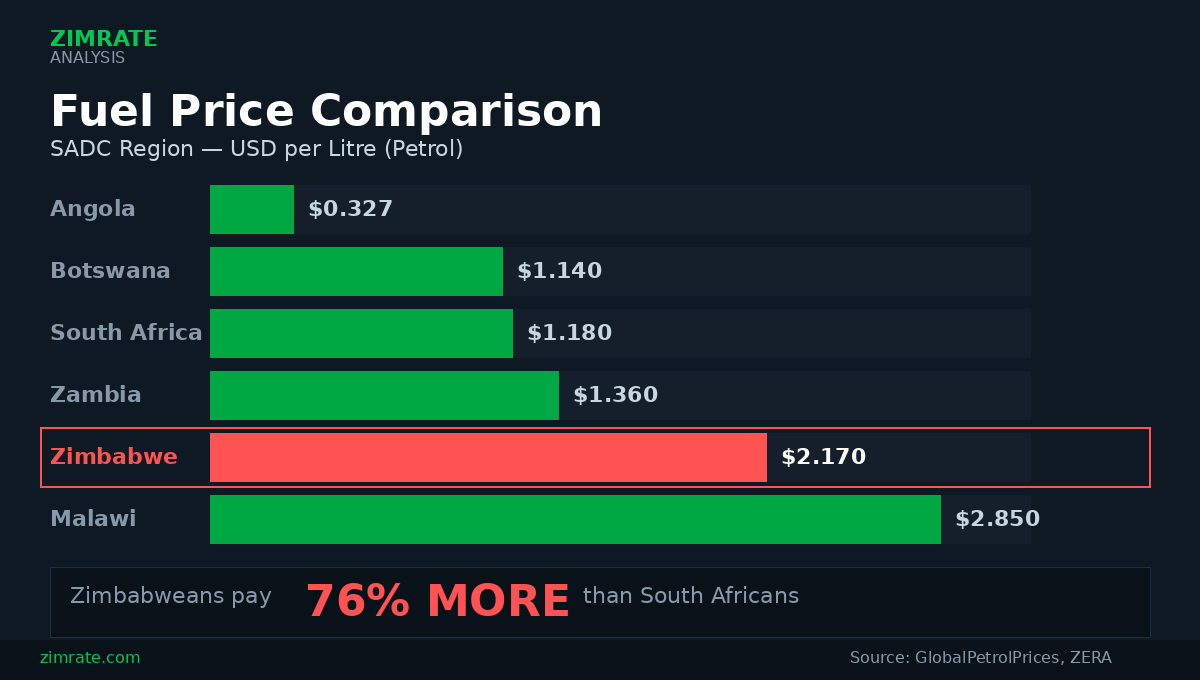
Zimbabweans are paying more for fuel than almost anyone else on the continent. Petrol now costs US$2.17 per litre and diesel US$2.05, making the country the most expensive fuel market in Southern Africa and second only to Malawi across the whole of Africa (NewsDay). The nearest regional comparison is not even close. South Africans pay US$1.27. Zambians pay US$1.40. Botswanan drivers fill up at US$1.15.
For a Harare commuter spending US$3 daily on transport, the numbers are not abstract. They determine whether the kombi fare to work leaves enough for mealie-meal.
What You Are Actually Paying For
Break down the pump price and a clear pattern emerges. The fuel itself is only part of the story. The government takes its cut before a single drop reaches your tank. Total taxes and levies add up to roughly US$0.63 per litre for petrol and US$0.57 for diesel (Zawya).
Here is the breakdown. An excise duty of US$0.30 per litre. A strategic reserve levy of US$0.127. A carbon tax of US$0.03. A debt repayment levy of US$0.057. A ZERA administrative fee of US$0.021. Add port handling charges and you have a system where the state collects nearly a third of every litre's price before the fuel dealer sees a cent. Dealers themselves take just US$0.06 to US$0.10 profit per litre (NewsDay).
Then there is the ethanol blending mandate. The government requires all petrol to be blended at E20 or E5 ratios. The domestic ethanol that goes into that blend costs roughly US$1.10 per litre, nearly double the global market average of US$0.60 to US$0.70 (Zawya). The supply is controlled by Green Fuel, a company linked to businessman Billy Rautenbach that operates as a protected monopoly. Consumers have no choice but to absorb the premium.
Neighbours Acted. Zimbabwe Did Not.
When global oil prices surged in March following the US-Iran conflict and the disruption of shipping through the Strait of Hormuz, governments across Southern Africa moved fast. Zambia suspended excise duty on fuel and zero-rated VAT. Namibia cut fuel levies by 50%. South Africa reduced its general fuel levy by three Rand per litre (Origins).
Zimbabwe's government promised "deliberate actions" and "interventions" when prices first breached the two-dollar mark in mid-March. Weeks later, nothing had materialised. No tax relief. No carbon tax suspension. No reduction in the administrative levies that account for nearly eighty-six cents of every litre purchased (Origins).
The landlocked argument does not hold either. Zambia is landlocked too. It has reformed its procurement model, maintained a stable exchange rate, and kept fuel prices 37% lower than Zimbabwe's (Zawya).
Why It Matters for the ZiG
Fuel is the connective tissue of Zimbabwe's economy. When pump prices rise, everything else follows. Transport costs go up. Bread prices go up. School fees go up. The Confederation of Zimbabwe Retailers has already warned against "unfair price increases" on basic commodities driven by fuel costs (Business Pulse Africa).
For anyone watching exchange rates on ZimRate, fuel pricing is a direct feed into inflation expectations. Every litre purchased at US$2.17 instead of the US$1.27 that South Africans pay is a drag on consumer spending power and formal sector competitiveness. The Delta Corporation's tax fight with ZIMRA highlights one side of the fiscal squeeze. Fuel pricing highlights the other: a government that taxes fuel heavily, promises relief, and delivers nothing.
With Brent crude still trading above US$100 per barrel and no sign of the Middle East conflict easing, Zimbabwe's fuel prices are likely to stay elevated. The only variable is whether the government decides to act, or continues to treat the pump as a revenue line item.
This article is for informational purposes only and does not constitute financial advice.


