
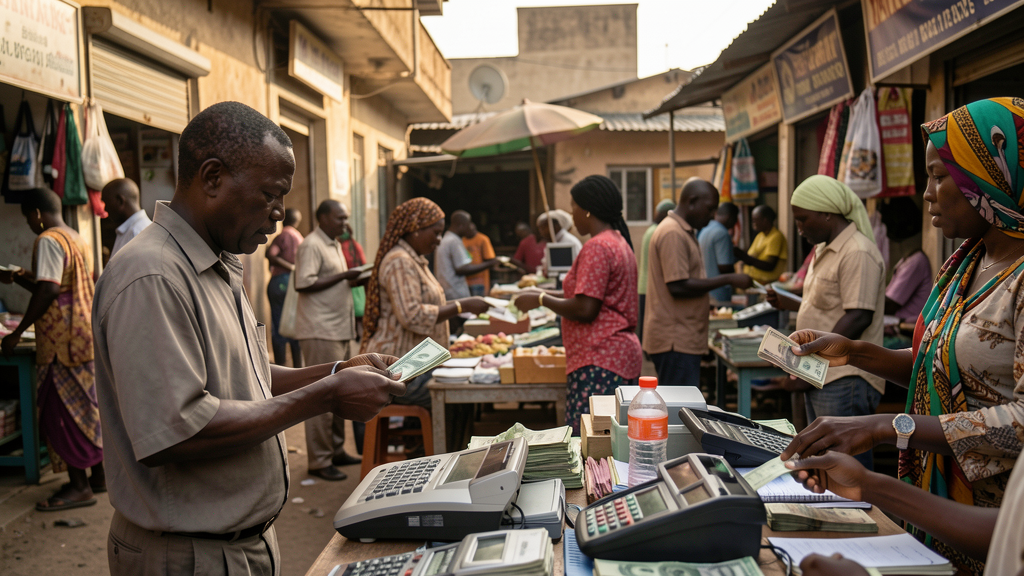
Why do people keep running back to the US dollar when a local currency comes under pressure? In Zimbabwe, that question is not abstract. It shapes how shops price goods, how firms hold working capital, and how banks fund business loans.
The broad explanation is familiar enough. When a local currency stops feeling reliable as a store of value, people move savings into something they trust more. An Al Majalla explainer republished by Zimbabwe Mail makes that point clearly: dollarisation takes hold when trust in the local unit weakens and the dollar becomes the safer place for savings, pricing and trade.
Zimbabwe gives that argument weight.
Reuters reported in July 2024 that foreign currencies were still being used in about 80 percent of local transactions, while ZiG accounted for roughly 20 percent (Reuters). That split alone explains a lot about business behaviour. If most trade still leans toward hard currency, companies will naturally try to protect cash flow, stock purchases and short-term savings in the same direction.
For small and medium-sized businesses, the issue is practical, not ideological. Inventory often has an imported component. Rent, fuel, software and supplier payments can all end up linked to the dollar.
If your costs are drifting toward hard currency, holding too much working capital in a weaker local unit starts to feel risky.
That pressure moves straight into the banking system. The Reserve Bank of Zimbabwe said in its 2025 Monetary Policy Statement that foreign currency deposits made up 83 percent of total deposits in December 2024. It also said foreign currency loans accounted for 88 percent of total private-sector credit.
Those are not side statistics. They show where trust and lending power are actually sitting.
So when people say Zimbabweans flock to the dollar, they do not just mean households hiding notes under mattresses. They also mean bank balance sheets, corporate treasuries and the conditions under which lenders decide who gets funded.
That matters for SMEs because credit availability depends on the type of deposits banks are attracting. If most deposits are in foreign currency, banks are more comfortable extending dollar-linked credit, especially to borrowers with export earnings or reliable hard-currency cash flows. Businesses without that profile can find themselves squeezed. They still need funding, but the currency mismatch gets harder to manage.
In other words, the trust problem becomes a credit problem.
The RBZ more or less admits the behavioural side of this. In the same policy statement, the central bank said liquidity challenges partly reflected the tendency in a dollarised economy to spend local currency while reserving foreign currency for store-of-value purposes. That is a neat central-bank phrase for a very human instinct: spend what you fear, keep what you trust.
Anyone running a small business in Zimbabwe already knows that instinct. You see it in how quickly firms convert receipts and how cautiously they price in local currency.
Reuters noted that ZiG was Zimbabwe's sixth attempt at a local currency in 15 years. That history matters because trust is cumulative, and so is distrust.
A new currency doesn't start with a blank slate. It inherits memories of earlier losses and sudden policy shifts.
That doesn't mean local-currency policy can't work. It means credibility has to be earned over time through consistency, reserve backing and disciplined money creation. Businesses usually judge policy through lived outcomes, not speeches.
Useful, yes. But deposits remain foreign-currency based, and lending still follows that balance-sheet reality.
For SMEs, the implication is straightforward. Access to credit is not only about whether banks want to lend. It is also about whether the business can borrow in the currency that matches its revenues and manage exchange risk.
So what does that mean for a small shop in Harare? Some firms can cope. Many smaller ones can't.
That is why dollar preference persists even when officials want wider use of the local currency. The dollar is not winning only because of habit. It still anchors pricing, savings behaviour and much of the banking system's funding base.
Readers tracking how currency confidence affects borrowing, pricing and business survival can follow broader market moves on ZimRate's homepage, check day-to-day conversions on the converter, and compare longer shifts on the exchange rate history page.
The real story here is not that people irrationally love the dollar. It is that in a fragile trust environment, the dollar keeps looking like the safer operating system for money. For Zimbabwe's SMEs and banks, that choice shapes everything from deposits to lending to survival itself.
This article is for informational purposes only and does not constitute financial advice.


