
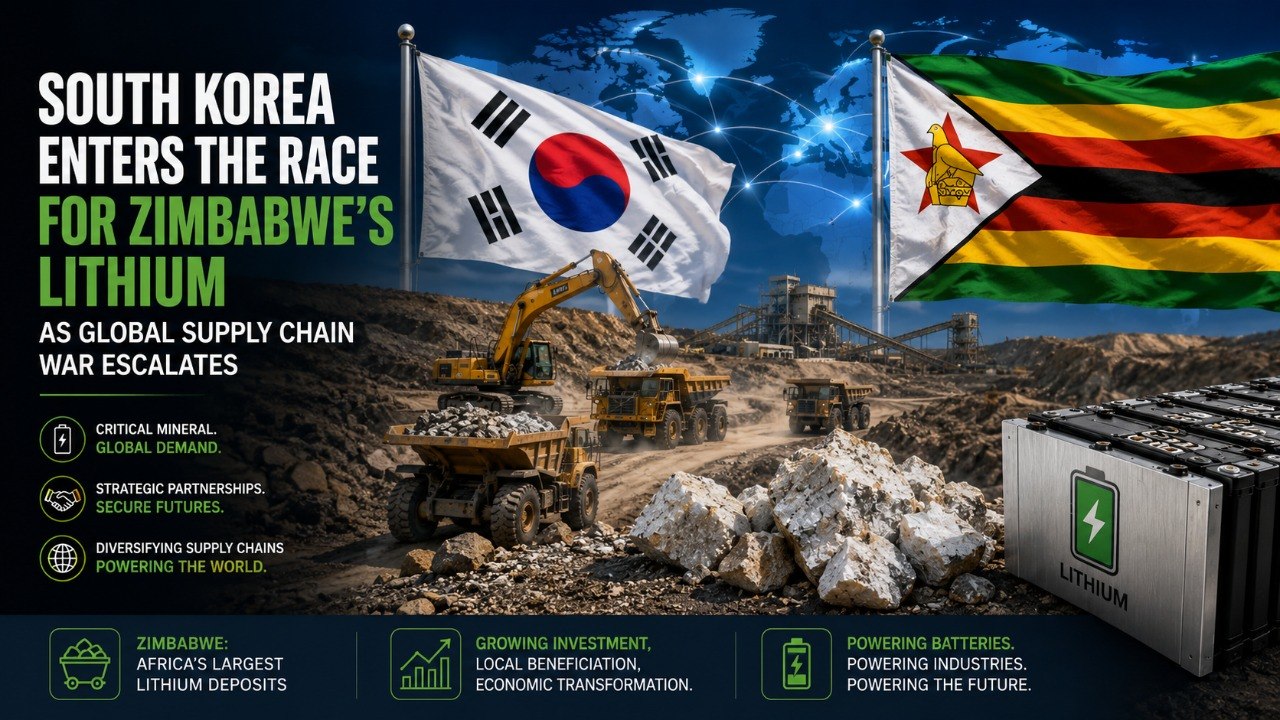
South Korea is positioning itself as the latest major economy to court Zimbabwe's lithium sector, signalling a strategic shift in how Seoul sources the minerals that power its massive battery and semiconductor industries. The move, announced at the Korea-Africa Foreign Ministers' Meeting on 1 June 2026, places Zimbabwe alongside Libya and Chad as priority partners in South Korea's expanding Africa strategy.
The diplomatic engagement saw South Korea's Foreign Minister hold talks with Zimbabwe's Deputy Foreign Minister Sheillah Chikomo, with critical minerals identified as a key priority area. Zimbabwe is Africa's largest lithium producer and sits on some of the world's most significant deposits of the battery metal. For South Korea, home to battery giants LG Energy Solution, Samsung SDI, and SK On, securing direct access to lithium feedstock is no longer optional. It is a matter of industrial survival.
Why South Korea Needs Zimbabwe
South Korea's interest is not driven by goodwill. It is driven by mathematics. According to the International Energy Agency, South Korea has committed to reducing its import dependence on a select few countries for critical minerals like lithium, cobalt, and graphite from 80 percent to 50 percent by 2030. The country also plans to increase mineral recycling from 2 percent to 20 percent over the same period.
The problem is structural. South Korea is one of the world's top three battery manufacturers, alongside China and Japan. But it has almost no domestic lithium production. Nearly all of its lithium feedstock comes from Australia and South America, processed predominantly through Chinese refining chains. When China tightened its grip on lithium processing and export controls in 2023 and 2024, South Korean manufacturers felt the squeeze immediately.
Zimbabwe offers a potential alternative. The country holds vast hard-rock lithium deposits, primarily in the Bikita and Kamativi regions. Chinese firms have already invested over US$1 billion in Zimbabwe's lithium sector, building processing plants and securing long-term supply agreements. South Korea now wants a seat at the same table.
Zimbabwe's Lithium Landscape
Zimbabwe's lithium sector has evolved rapidly. In 2022, the government banned the export of raw lithium ore, forcing miners to process material locally before shipping. In 2025, the ban was extended to lithium concentrates, with a full export restriction scheduled for January 2027. The policy is designed to force value addition on Zimbabwean soil, creating jobs and capturing more of the value chain domestically.
The approach has attracted massive Chinese investment. Companies like Zhejiang Huayou Cobalt, Sinomine Resource Group, and Chengxin Lithium have built processing facilities across the country. In early 2026, Huayou Cobalt shipped Africa's first ever lithium sulphate from Zimbabwe, a milestone that demonstrated the country's emerging beneficiation capability.
For South Korea, this creates both opportunity and challenge. The opportunity is clear: Zimbabwe has the raw material and is building the infrastructure to process it. The challenge is that Chinese firms are already deeply embedded in the supply chain, and displacing them will require significant investment, technology transfer, and diplomatic effort.
The Bigger Picture: A Three-Way Race
Zimbabwe's lithium is becoming a geopolitical flashpoint. China dominates the sector with over US$1 billion in committed investment and controls most of the processing capacity on the ground. The United States has been making diplomatic overtures through the 2026 Critical Minerals Ministerial, which brought together 54 nations to discuss supply chain diversification. Now South Korea is entering the conversation directly.
The competition is not just about who gets the lithium. It is about who controls the processing, the logistics, and the long-term supply agreements that determine pricing power. Zimbabwe's government appears aware of its leverage. The export ban strategy, the quota reviews for lithium producers, and the insistence on local processing are all designed to extract maximum value from a market where demand is rising faster than supply.
For Zimbabwe, multiple bidders are better than one. Having South Korea compete with China for access to Zimbabwean lithium could drive up the value of mining concessions, attract new investment into processing infrastructure, and give the government more negotiating power on tax, royalties, and local content requirements.
What It Means for the ZiG and the Economy
Foreign investment in mining has direct implications for Zimbabwe's currency and fiscal position. Mining is the country's largest source of foreign currency. In Q1 2026, mineral sales reached US$983.85 million, up 79 percent year-on-year. If South Korean firms enter the market with fresh capital, the additional forex inflows would strengthen the ZiG's backing and ease the liquidity constraints that have plagued the economy.
There is also a skills and technology dimension. South Korean firms typically bring higher technical standards and more rigorous environmental and safety practices than some existing operators. If Seoul's engagement leads to joint ventures or technology partnerships rather than pure extraction deals, Zimbabwe could benefit from knowledge transfer that builds long-term industrial capacity.
The Korea-Africa Foreign Ministers' Meeting is just the opening move. Whether it translates into actual investment depends on what happens next: site visits, feasibility studies, government-to-government frameworks, and the fine print of any mining agreements. But the signal is clear. Zimbabwe's lithium is no longer just a Chinese story. It is becoming a global one.
For live exchange rates and market data, visit the ZimRate live rates dashboard. For more on Zimbabwe's mining and economic landscape, check our blog.


