
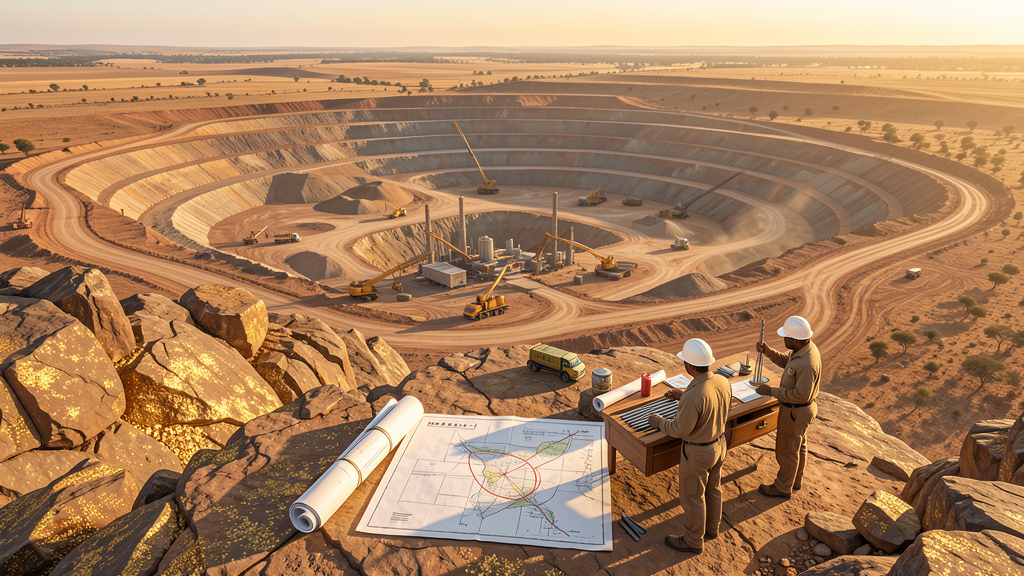
Caledonia Mining has given Zimbabwe's gold story a fresh angle after reporting high-grade drill results at Motapa, an exploration property that sits next to the much larger Bilboes project.
This is not a production jump story. Not yet. It is a development story about whether Motapa can add enough nearby ore to improve Bilboes over time.
For Zimbabwe, that's the part that matters. Gold remains one of the country's key export earners, so any project that could deepen future output deserves attention. Readers tracking the wider market can use ZimRate's live rate pages and the history section to watch how export sentiment feeds into the broader economy.
What the drilling showed
Caledonia said Motapa North returned the strongest reported intersections, including 19 metres at 8.08 grams a tonne of gold, 6.38 metres at 13.95 g/t, 12 metres at 7.12 g/t and 14 metres at 4.31 g/t. At Motapa Central, the company highlighted 7 metres at 2.39 g/t, 3 metres at 4.79 g/t and 2 metres at 5.25 g/t. Management says the results support the case for Motapa to become a strategic extension of Bilboes (Mining Weekly).
Caledonia also says it expects a maiden mineral resource estimate for parts of Motapa in the third quarter of 2026. That's important because Motapa is still an exploration story, not a producing mine and not yet a fully defined resource. So the right reading is simple: promising, yes, but not proven yet.
Why Bilboes is the real economic story
Motapa matters because of where it sits. Bilboes is the anchor project, and Reuters reported earlier this year that Caledonia plans to spend $132 million in 2026 on Bilboes as part of a wider $162.5 million capital programme. Bilboes is targeted to start production in late 2028 and is expected to reach 200,000 ounces a year from 2029, which would make it Zimbabwe's largest gold mine (Reuters).
That gives Motapa strategic weight. If the nearby ground keeps yielding workable ore, Caledonia could use shared infrastructure and mine planning to make Bilboes more valuable than it looked on its own. That's the company line, but it also makes commercial sense. Nearby tonnes can change mine life, sequencing and future production flexibility.
There is also a financing angle. Reuters reported in February that Caledonia raised $150 million for Bilboes and that demand ran above $600 million. That doesn't erase Zimbabwe risk, obviously, but it does show that investors are willing to fund a large Zimbabwean gold asset when the numbers look good.
So what?
There are three reasons this update matters beyond mining headlines.
First, bigger gold projects matter for export earnings. If Bilboes reaches the scale Caledonia is targeting and Motapa later adds support around it, Zimbabwe's future gold pipeline gets deeper.
Second, it speaks to investor confidence. A project of this size pulling real capital into Zimbabwe is a signal worth watching, even if policy risk remains very real.
Third, it gives readers a cleaner way to think about the broader economy. Stronger gold projects can shape future capital inflows, contractor demand and foreign-currency earnings, all of which eventually feed into the climate people watch when they check the USD to ZiG path.
Still early.
What to avoid overstating
It would be a mistake to treat this as a direct ZiG-backing story or as proof that new production is around the corner. Motapa still needs the resource statement, and Bilboes still needs to stay on track toward first gold in Q4 2028. This is a useful project-development update, not a finished macro victory lap.
There is also a naming trap here. Some local coverage framed this as Caledonia's Bubi gold project, but the cleaner version is that Motapa sits in the Bubi belt beside Bilboes. Readers shouldn't come away thinking Motapa has replaced Bilboes as the core project. It hasn't.
The bottom line
Caledonia's Motapa drill update is worth watching because it could improve the long-term case for Bilboes, not because it instantly creates a new producing mine. The next real checkpoint is the expected Q3 2026 resource estimate. If that lands well, Motapa could become an important supporting asset in one of Zimbabwe's biggest future gold developments.
This article is for informational purposes only and does not constitute financial advice.